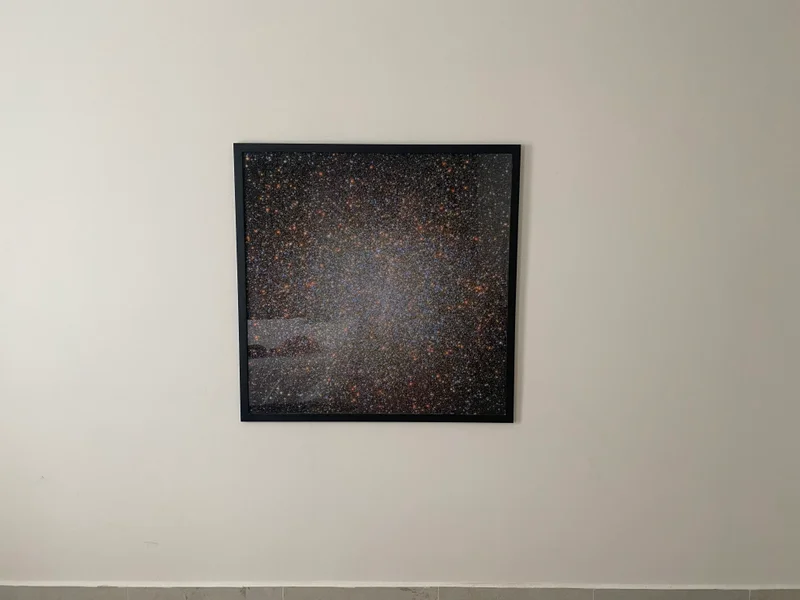
Travel back in time. The year is 1986. Halley's Comet graces our skies, Voyager 2 is exploring Uranus, and at the La Silla Observatory in Chile, astronomers are capturing this breathtaking portrait of our cosmic neighbor.
This isn't a digital rendering; it's a piece of history, a timeless view of the Large Magellanic Cloud captured through the legendary ESO 1-metre Schmidt telescope.
You're not just buying a print—you're owning a moment from a golden age of astronomy.
The ESO 1-meter Schmidt telescope that captured this image had been operational at La Silla since 1971, representing the pinnacle of wide-field astronomical photography technology. With its impressive four-degree field of view—covering an area equivalent to 64 full moons—this instrument could capture the entire Large Magellanic Cloud in unprecedented detail for its time.

The Large Magellanic Cloud: A Cosmic Laboratory 170,000 Light-Years Away
The Large Magellanic Cloud isn't just our galaxy's largest satellite—it's a cosmic time machine that allows us to study galactic evolution in ways impossible within our own Milky Way. At approximately 170,000 light-years from Earth, this dwarf galaxy contains roughly 30 billion stars and serves as the most active star-forming region in our Local Group.
What makes this 1986 image particularly significant is that it captures the LMC during a crucial period of astronomical understanding. The 1980s marked a revolution in our comprehension of the Magellanic system, with studies revealing the complex gravitational dance between the Large and Small Magellanic Clouds and their interaction with our galaxy. This photograph documents the LMC as astronomers were just beginning to understand its true nature and orbital dynamics.
The Golden Age of Schmidt Telescope Photography
The Schmidt telescope design, perfected in the early 20th century, reached its zenith in the 1980s at observatories like La Silla. These remarkable instruments combined wide fields of view with exceptional image quality, making them perfect for surveying entire galaxies and hunting for transient objects. The ESO 1-meter Schmidt was among the most productive survey telescopes of its era, contributing to numerous discoveries including comets, asteroids, and variable stars.
This 1986 image represents the pinnacle of photographic astronomy—captured during the final golden years before digital CCD cameras revolutionized astronomical imaging. Each photographic plate required precise timing, careful processing, and represented hours of exposure time under Chile's pristine dark skies.
A Scientific Document of Extraordinary Beauty
Beyond its historical significance, this image showcases the breathtaking structure of our neighboring galaxy. You can see the LMC's distinctive bar-shaped central region, its sprawling spiral arms rich with star-forming regions, and the intricate network of dust lanes and emission nebulae that paint this cosmic masterpiece. The famous Tarantula Nebula, visible as one of the brightest regions, represents one of the most luminous star-forming regions known in the Local Group.
The scientific value of this observation extends far beyond its visual impact. Wide-field images like this one provided crucial data for understanding galactic structure, stellar populations, and the distribution of interstellar matter. In 1986, astronomers were using such images to map the LMC's stellar content and begin unraveling its complex interaction history with both our galaxy and the Small Magellanic Cloud.
An Archived Treasure, Revived for Your Walls
At Astrography, we believe the story of space is told through images both new and old. We delve deep into astronomical archives to unearth gems like this—images that are not only beautiful but also culturally and scientifically significant.
We bring this piece of history to you with our unwavering commitment to quality:
-
Museum-Grade Fine Art Print: We use archival papers and pigment inks to create a gallery-quality piece with a certified lifespan of over 200 years. This is an investment in art, science, and history.
-
Budget-Friendly Poster: Enjoy the same iconic view on high-quality paper, perfect for bringing a touch of vintage cosmic flair to an office, dorm room, or living space.
A Unique Statement for the Discerning Collector
This print is for those who walk their own path and appreciate authenticity.
-
For the Space and Science Historian: A tangible link to the methods and discoveries of 20th-century astronomy.
-
For the Interior Designer: A sophisticated, retro focal point that adds intellectual depth and a unique story to any design.
-
For the Art Lover: A minimalist, powerful piece of abstract natural art with a compelling backstory.
-
For the Perfect Gift: Give something truly original—a piece of the universe as it was seen in 1986.
Why This 1986 Image Matters
This photograph captures more than just the Large Magellanic Cloud—it preserves a moment when humanity's understanding of our cosmic neighborhood was rapidly expanding. The late 1980s saw revolutionary discoveries about galaxy formation, stellar evolution, and the structure of the Local Group, many of which were enabled by wide-field survey telescopes like the ESO Schmidt.
When you display this image, you're not just showing a beautiful galaxy—you're honoring the dedicated astronomers who spent countless nights at remote mountaintop observatories, pushing the boundaries of what was possible with film-based astronomy. It's a testament to human curiosity and our relentless drive to understand our place in the universe.
Own a piece of astronomical history. Experience the Large Magellanic Cloud as captured during the golden age of wide-field photography.


 Collected by this store· 0 found this helpful