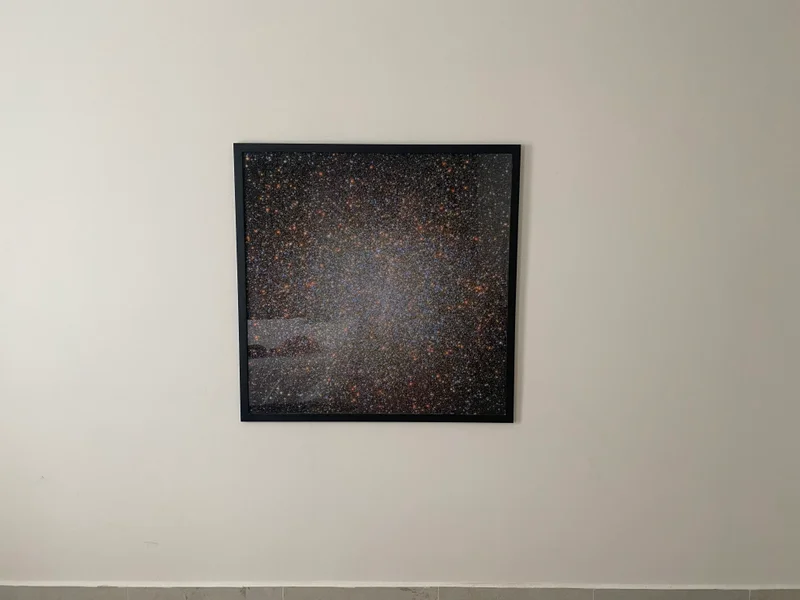
Watch a dark cosmic cloud come alive. Euclid’s infrared vision pierces the dust of Orion to reveal hundreds of newborn stars, captured here as a fine art print or budget‑friendly poster, crafted to transform your space into a quiet, cosmic observatory.
A quiet storm of newborn stars, on your wall
At first glance, this region of Orion looks like empty darkness. Through Euclid’s infrared eyes, it becomes a living nursery of stars: rivers of blue‑grey gas, warm copper dust, and tiny magenta outflows where new suns are being born inside the dark cloud LDN 1641.
This poster turns a cutting‑edge ESA Euclid observation into a statement piece for your home, studio, or gallery—uniting scientific wonder with gallery‑grade aesthetics.
Who this print is for
-
Art collectors seeking rare, story‑driven space imagery with verifiable scientific provenance.
-
Space & science lovers who follow missions like Euclid and want a daily reminder of why they fell in love with the cosmos.
-
Interior designers looking for sophisticated, non‑generic artwork that quietly commands attention and sparks conversation.
-
People crafting an original space—home offices, creative studios, listening rooms, home theaters, reading nooks.
-
Gift seekers searching for something meaningful for astronomy fans, STEM students, science teachers, and curious minds of all ages.

The story behind “Dark Cloud’s Dusty Veil”
Hidden inside the constellation Orion lies a dark cloud called LDN 1641, about 1300 light‑years away. In visible light, this region looks almost empty—dust grains block starlight so efficiently that the sky appears nearly black.
Euclid changes that. Using its near‑infrared NISP instrument, the telescope can see the light that slips through and around those tiny dust particles. In this image, what once looked like nothing becomes:
- A tapestry of hundreds of stars shining through gas and dust.
-
Very young stars still wrapped in their birth cocoons, some ejecting material that shows up as magenta knots and coils.
- A gradual opening toward the deeper Universe in the upper left, where dust thins and distant galaxies begin to appear.
This field was initially observed in September 2023 not for beauty, but for precision: engineers needed a relatively star‑sparse visible‑light field to fine‑tune Euclid’s pointing accuracy. The test was so successful that it left behind this stunning, 0.64‑square‑degree window—over three times the area of the full Moon on the sky—recorded in just under five hours.
Euclid’s main mission is to map the 3D structure of the Universe and help unravel the mysteries of dark matter and dark energy. Along the way, it is also gifting us scenes like this: intimate portraits of our own galaxy’s hidden star‑forming regions.
Technical note for enthusiasts: this color image combines NISP observations in Y, J, and H bands, mapped to blue, green, and red channels. Image processing by M. Schirmer (MPIA, Heidelberg).
Why buy from Astrography
- Curated catalogue of only the most meaningful, visually striking space images.
- Museum‑ and gallery‑grade production standards on fine art papers with archival inks (life expectancy 200+ years under proper care).
- Carefully managed color and contrast to preserve both the scientific structure and the emotional impact of the scene.
- Options tailored to your budget and space: from collectible fine art prints to accessible posters.
Bring this hidden star nursery out of the dark and into your daily life.
Choose your size and finish now, add “Dark Cloud’s Dusty Veil” to your cart, and let Euclid’s newborn stars quietly transform your space.