Marzena Rogozińska: Antares and Rho Ophiuchi Cloud Complex

Marzena Rogozińska: Antares and Rho Ophiuchi Cloud Complex

🚀 Premium Astrography™ Print
Rated 4.9 out of 5
Based on 73 reviews

Units:
Type
Size
Regular price$59.00
/
Shipping calculated at checkout.

Fine Art™ or Poster™ Print Tube:

⚡ Your Print (rolled)
Frame not included - our customers usually use local manufacturers and make frames to size or use ready-made, widely available designs

Shipping/Delivery Time: Shipping and delivery times are separate from the manufacturing process.

Standard Manufacturing Time: up to 7 business days (excluding weekends and holidays). 

Delivery Time: average delivery takes between 3 to 7 business days.

Shipping Assurance (optional): your order is protected from loss, theft, or damage—even after unboxing. Plus, our quick claims process ensures hassle-free resolutions (we will send a replacement with no questions asked).

In our small creative studio, each Astrography treasure is handcrafted just for you. While we prioritize stellar quality over speed, forgive us if we're a tad tardy.

Delays? Holidays, global events, or distant locations might be the culprits. If a change of heart strikes, send it back within 14 days, no questions. Dive into our Shipping & Returns page for details.

Your trust means the Universe to us! 🚀

    We curated a premium print network, so your cosmic prints are crafted at local labs in your region, ensuring you receive them quickly without paying customs duties or taxes, or at least reducing them.

    Customers outside the EU may be charged additional taxes and duties. Information about any payments will be provided by the company delivering the package.

    Customers are responsible for any applicable taxes, duties, or tariffs

    Manufacturer contact information
    Name: Astrography Sp. z o.o.
    Email address: support@astrography.com
    Postal address: ul. Poznańska 55, loc. 28 (Nordspace), 05-850 Jawczyce, Poland/EU

    Age restrictions: This product is made for adults
    EU Warranty: 2 year warranty in EEA and UK, established by Directive 1999/44/EC.

    Other compliance information: Meets the small parts and magnetic flux index level requirements. Inks: Water-based pigment inks (EPSON UltraChrome Pro12, Canon Lucia PRO Ink) or eco-solvent inks (UltraChrome GS3).

    Hazards Identification
    Classification (EC 1272/2008):
    Not classified as hazardous. Adverse Effects: None identified. 

    Please note that this product is suitable for indoor use only. Meets the lead level requirements.

    A psychologist and educator by profession, has been engaged in astrophotography since 2020, combining science, art, and travel. She has photographed, among others, the Milky Way in Europe and Hawaii, the aurora borealis in Norway and Iceland, a total solar eclipse in the USA, and southern sky objects in Namibia.

    She develops projects, publishes her photographs in astronomical magazines, and conducts workshops and lectures. Her work has been distinguished twice within NASA’s Astronomy Picture of the Day (APOD) project (2021 and 2025).

    Marzena Rogozińska: Antares and Rho Ophiuchi Cloud Complex – A Masterpiece of Cosmic Artistry and Science

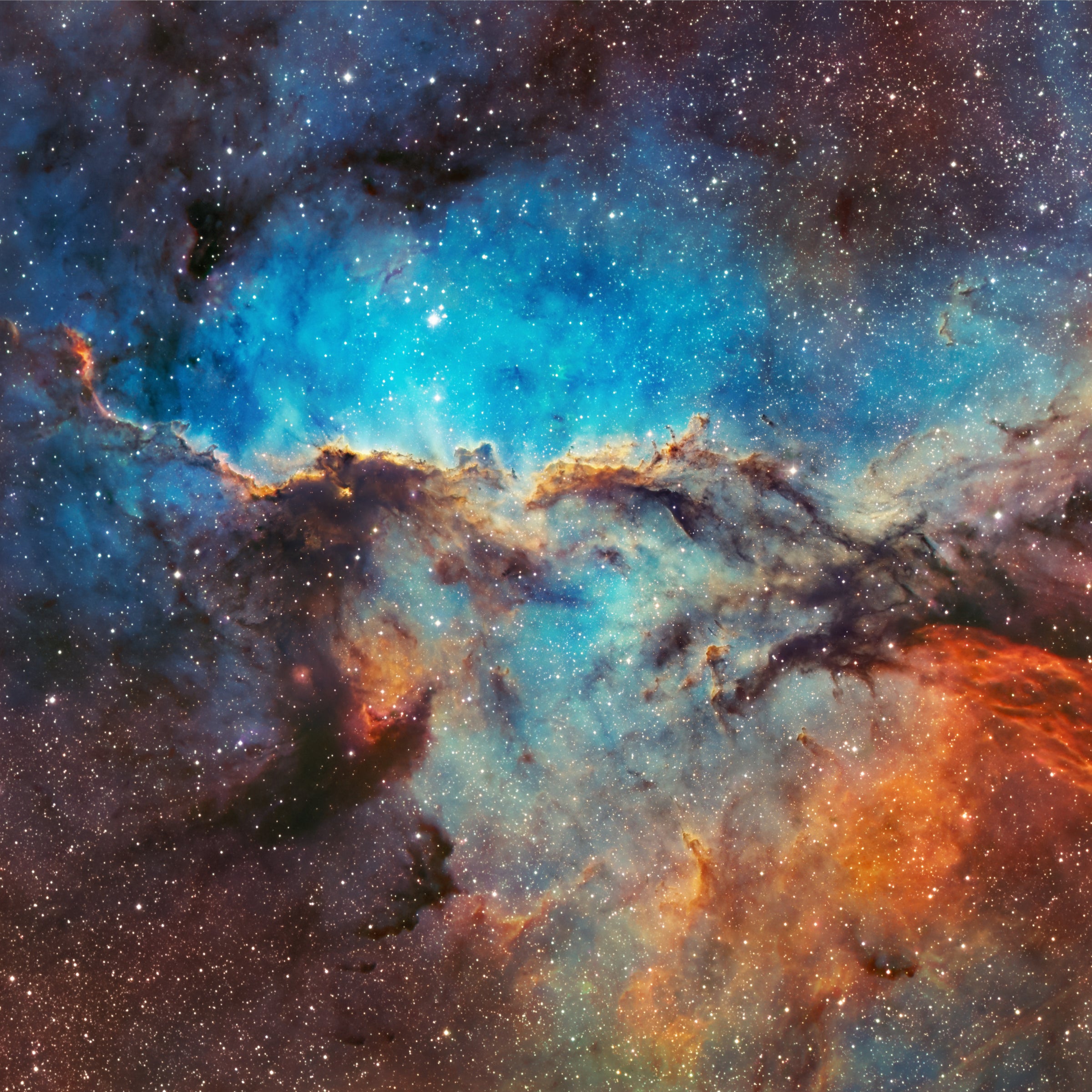
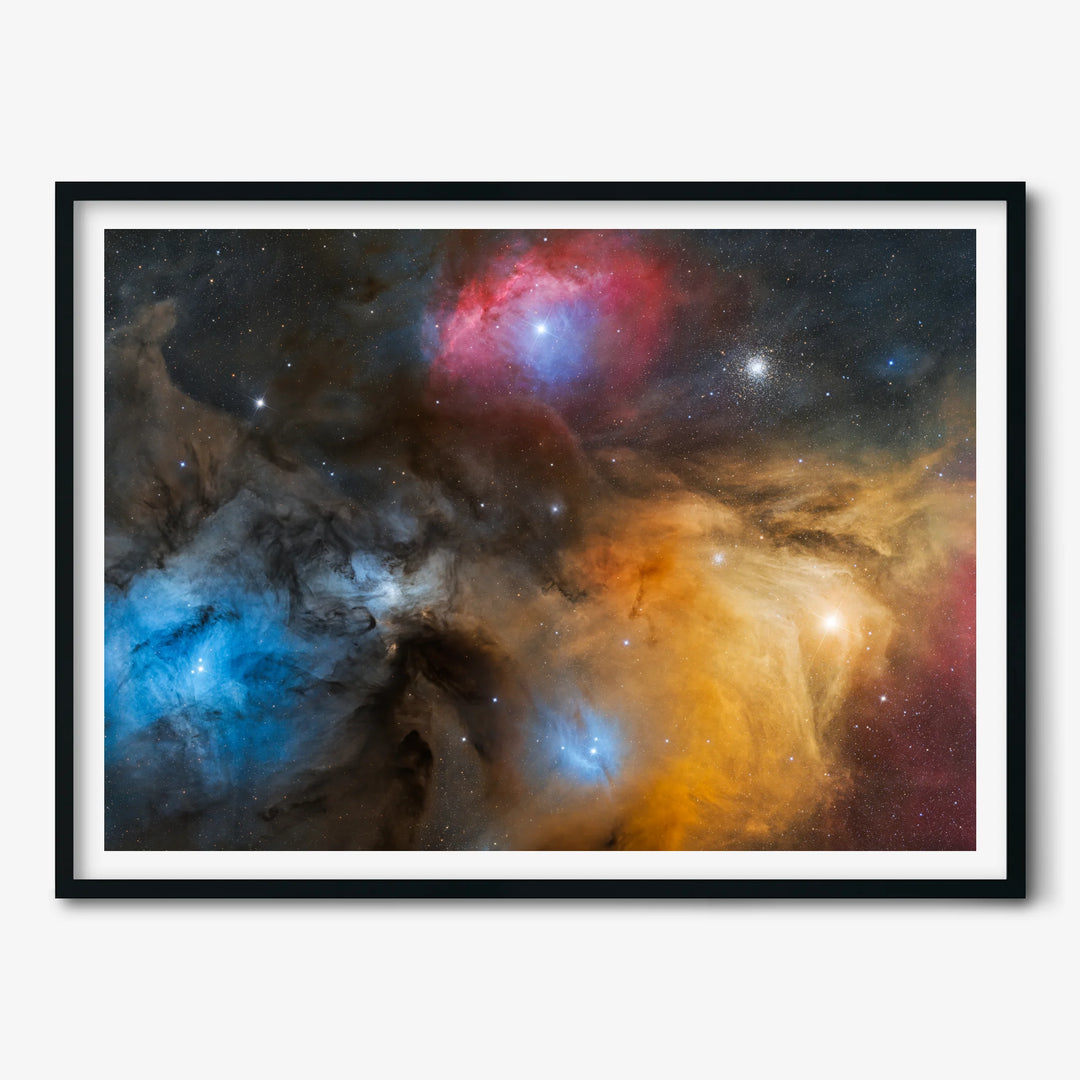
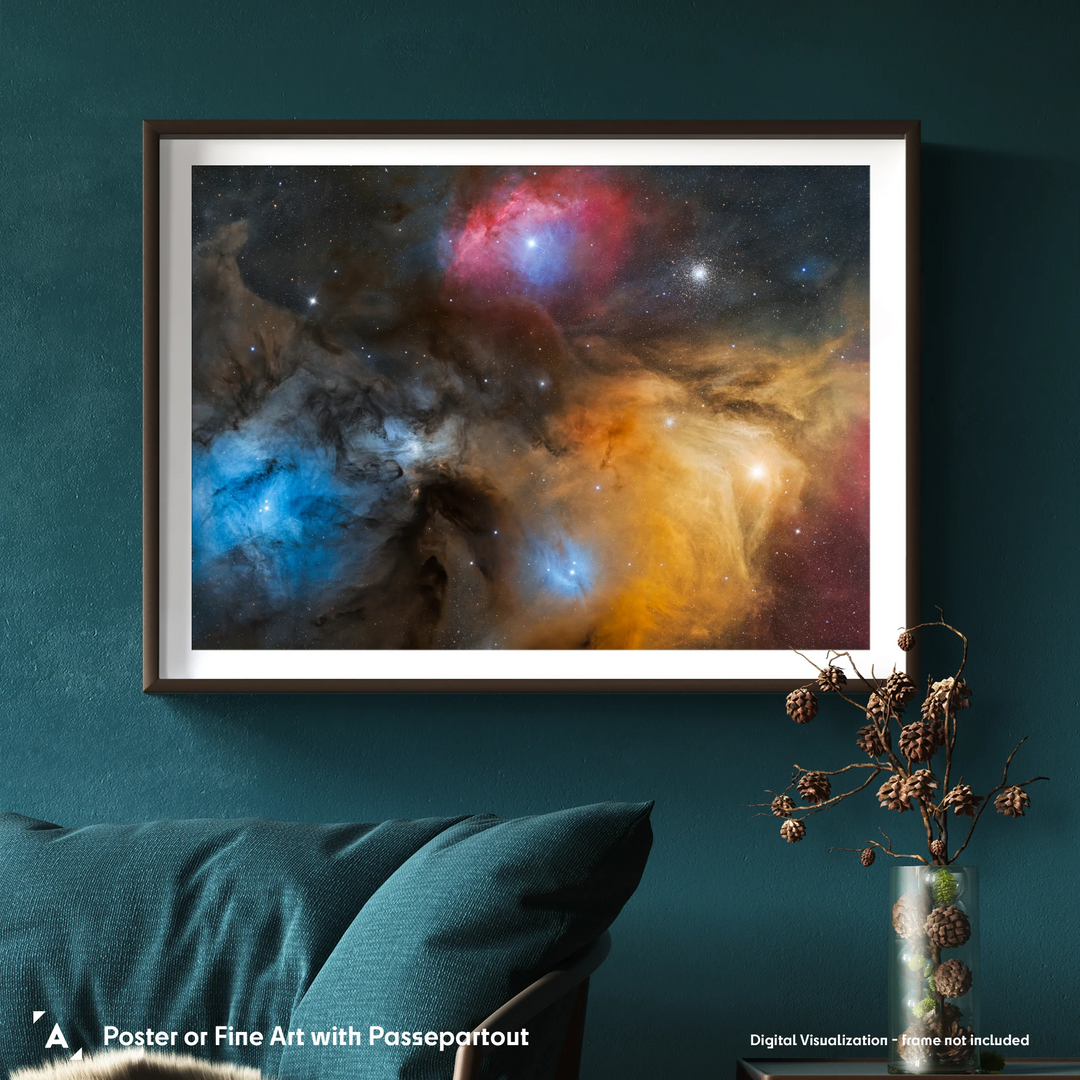
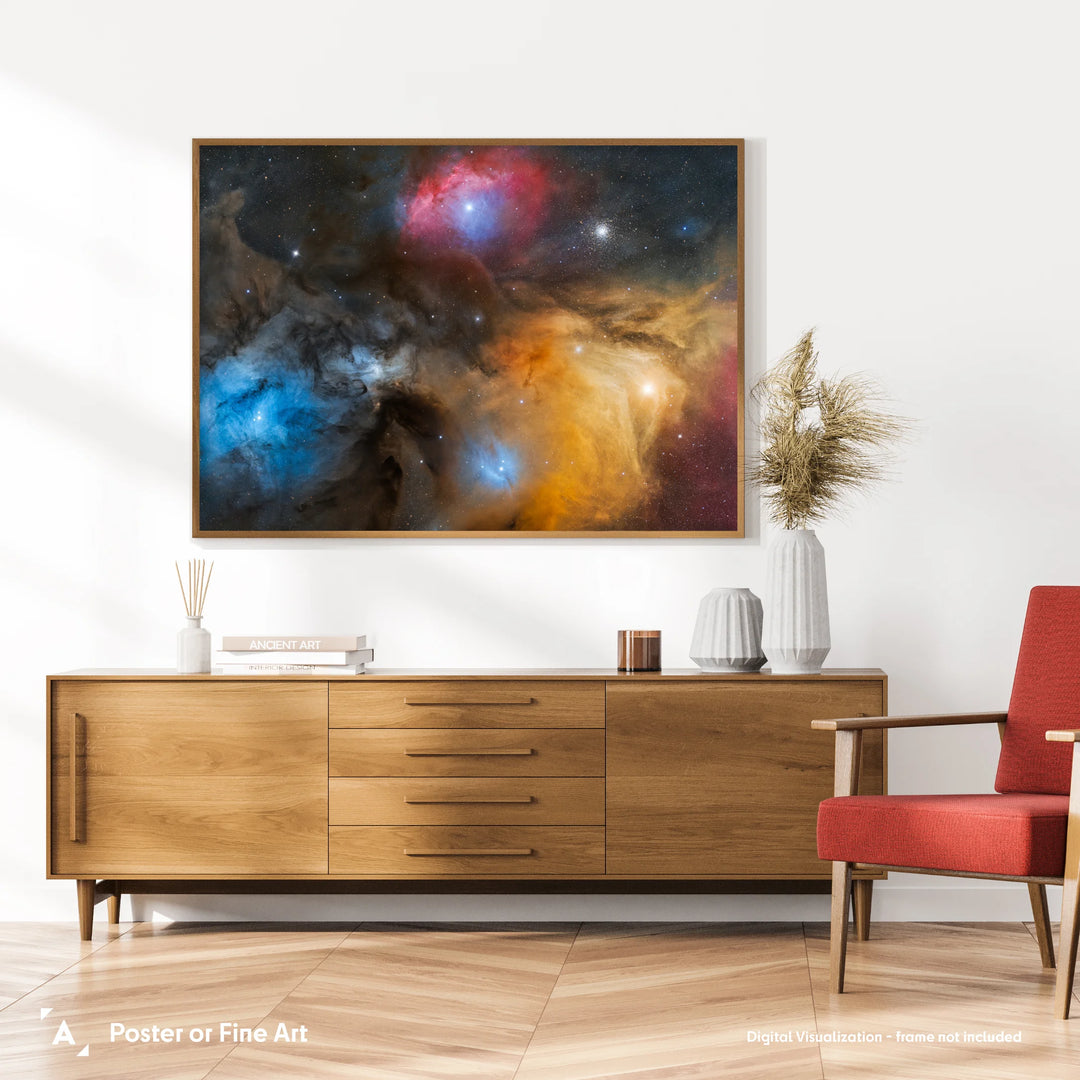
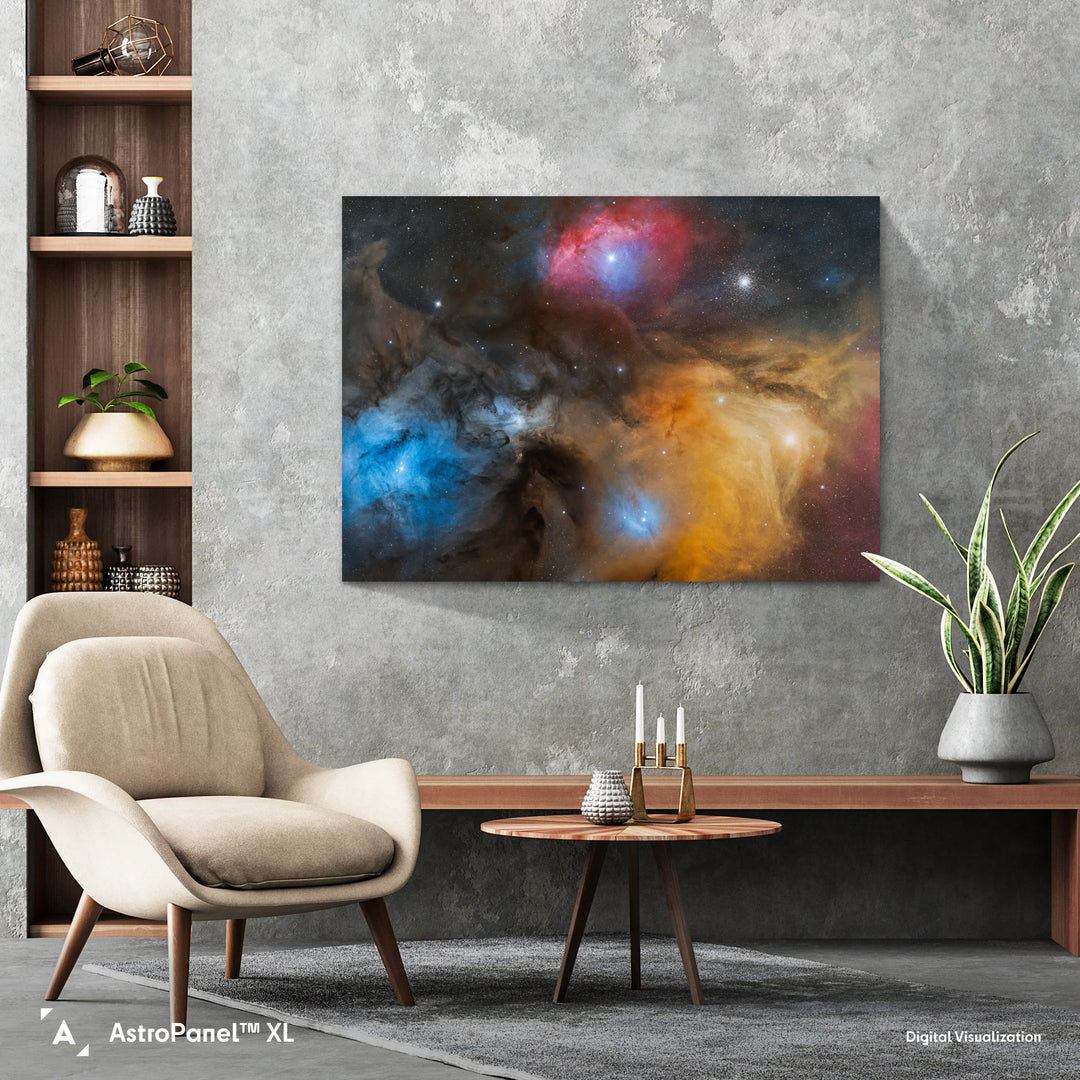
    On the border between the constellations Scorpius and Ophiuchus lies one of the most extraordinary and colorful regions in the entire night sky—a place where blue reflection nebulae, golden emission regions, and dark dust clouds converge in a cosmic symphony of light and shadow. At its heart sits Antares, one of the largest and most luminous stars known to humanity. Around it swirl the mysterious Rho Ophiuchi cloud complex, a vast stellar nursery where young stars illuminate the interstellar medium in hues of crimson, amber, and sapphire.

    This is the region Marzena Rogozińska traveled to the darkest skies on Earth to capture—and what emerged is a three-panel mosaic that reveals the complexity, depth, and staggering artistry of this cosmic landscape in unprecedented detail.

    The Celestial Theater: Understanding What You're Seeing

    Antares: A Dying Red Supergiant at the Heart of Everything

    The dominant feature of this image is Antares, the brightest star in the constellation Scorpius and the 15th brightest star visible from Earth. But numbers fail to capture what Antares truly is: a cosmic giant in its death throes.

    Antares is classified as an M1 red supergiant—a massive star with a surface temperature of only 3,400 degrees Celsius (roughly 60% of our Sun's), yet it shines approximately 10,000 times brighter than our entire Sun. How is this possible? Size. Antares is so monumentally vast that if placed at the center of our solar system, its surface would extend nearly to Jupiter's orbit. Its diameter is approximately 700 times larger than our Sun.

    The star's color—a brilliant ruby red—results from its relatively cool surface temperature. That golden-yellow glow surrounding Antares in the image is a rare yellow reflection nebula, created when light from this colossal star bounces off nearby interstellar dust and gas. Such yellow reflection nebulae around Antares are extraordinarily unusual; most reflection nebulae glow blue (because blue light scatters more efficiently through dust).

    Antares is approaching the end of its life cycle. Within the next few million years—cosmically speaking, an eyeblink—this red supergiant will likely detonate as a supernova, briefly outshining its entire galaxy.

    The Rho Ophiuchi Triple Star: Blue Light in Darkness

    Approximately 3 degrees north of Antares sits the triple star system Rho Ophiuchi, surrounded by the brilliant blue reflection nebula IC 4604. This blue glow is the signature of a reflection nebula—dust illuminated by the light of nearby young, hot blue stars.

    The blue coloration dominates because blue light has a shorter wavelength than red light and scatters more efficiently when passing through cosmic dust. This is the same physical principle that makes Earth's sky appear blue: Rayleigh scattering of shorter-wavelength light.

    Rho Ophiuchi is only about 460 light-years from Earth, making it one of our nearest star-forming regions. The triple-star system itself lies approximately 65 light-years in front of the dust clouds we observe, creating a layered three-dimensional landscape of stellar objects and nebulae at vastly different distances.

    The Dark Nebulae: Where Stars Cradle

    Interspersed throughout the image are dark nebulae—Barnard 44, Barnard 45, Lynds 1688, and Lynds 1689. These are not empty voids; rather, they are extraordinarily dense clouds of cold molecular gas and dust, so thick that they obscure the light of background stars entirely. These dark regions are actually stellar nurseries—the very places where new stars are being born.

    The dark lanes visible in the image represent trillions of dust particles blocking the light from distant stars behind them. To our eyes, this creates a stark, dramatic contrast with the glowing nebulae—a visual representation of the universe's raw creative force.

    Emission Nebulae in Red: Hydrogen Glowing with Purpose

    The reddish areas throughout the image are emission nebulae, created when intense ultraviolet radiation from young, hot stars ionizes hydrogen gas. As these hydrogen atoms recombine with electrons, they emit light at a characteristic red wavelength (656 nanometers, known as the Hydrogen-alpha or H-alpha line).

    These red emission regions are the "evidence" of active star formation—proof that young, energetic stars are lighting up the surrounding nebula.

    Supporting Cast: Globular Cluster M4 and Beyond

    To the southeast lies the globular cluster M4, a dense spherical collection of hundreds of thousands of ancient stars. The small globular cluster NGC 6144 also appears in the field. These are not actively forming stars like the young stellar objects in the Rho Ophiuchi complex; rather, they are ancient stellar cities, having formed billions of years ago.

    The three-dimensional structure of this region is staggering: Antares is 90 light-years beyond the Rho Ophiuchi complex, Sigma Scorpii is 300 light-years beyond it, and globular cluster M4 sits an astonishing 6,500 light-years distant. Yet in this single image, we see them all unified, layered like a cosmic painting.

    The Capture: 13.5 Hours Under Namibia's Pristine Skies

    Marzena Rogozińska captured this image during an astrophotography expedition to Hakos Astrofarma in Namibia, in May 2025. Hakos is located at an altitude of over 1,800 meters on Namibia's Great Escarpment, situated between the Savannah High Plateau and the Namib Desert.

    Hakos is classified as Bortle 1—the darkest possible classification on the Bortle Dark-Sky Scale. This means virtually zero light pollution from artificial sources, pristine atmospheric transparency, and seeing conditions that are among the finest on Earth. The combination of altitude, latitude (23 degrees south of the equator), low humidity, and isolation makes Hakos one of the world's premier astrophotography destinations.

    Over several clear nights, Marzena deployed a portable deep-sky imaging setup optimized for field work. The three-panel mosaic required a total integration time of 13.5 hours—meaning the camera's sensor accumulated light for a combined 13.5 hours across all panels, gathering data from even the faintest dust structures and nebular details.

    The processing and assembly of a three-panel mosaic of this quality required meticulous work: geometric registration of each frame, color balancing across panels, blending of overlapping regions, and enhancement of subtle details in faint nebulosity. The result is a seamless panorama that reveals details invisible from Northern Hemisphere observatories and accessible only under the world's darkest skies.

    Technical Details

    • Date and Location: May 2025, Hakos Astrofarma, Namibia
    • Telescope: Takahashi Epsilon 130D
    • Camera: ZWO ASI 2600MC Pro
    • Filter: UV/IR Cut
    • Mount: ZWO AM5, controlled via ASIAIR Pro
    • Integration Time: 3 panels, total 13.5 hours
    • Software: PixInsight, Astro Pixel Processor (APP), Photoshop

    Awards

    • Gold Award – Astrophotography Prize
    • Top Pick – AstroBin

    Who This Print Is Perfect For

    • Deep-sky astronomers and planetary scientists fascinated by stellar evolution and star formation
    • Art collectors seeking imagery that merges cosmic science with gallery-worthy visual impact
    • Southern Hemisphere enthusiasts or those who have visited Namibia and hold it close to their hearts
    • Science educators looking for powerful teaching tools about nebulae, stellar classes, and the life cycles of stars
    • Interior designers creating spaces that inspire wonder and curiosity
    • Anyone who understands that the night sky is humanity's greatest teacher, and wants to live beneath its wisdom daily
    • Gift seekers looking for something rare, meaningful, and utterly unforgettable

    Museum-Grade Fine Art Meets Budget-Conscious Access

    At Astrography, Marzena's masterpiece is available in formats suited to every vision and every budget:

    Fine Art Print – For Collectors and Lifelong Displays

    • Giclée printed on premium archival matte paper with pigment-based inks, engineered for a lifespan exceeding 200 years without noticeable fading
    • Exceptional detail rendering, smooth color gradations across nebular regions, and deep blacks in dust lanes
    • The level of craftsmanship and longevity expected in museum exhibitions and high-end galleries
    • Ideal for art collectors, institutions, and anyone who wants a permanent, irreplaceable centerpiece

    Poster – High-Impact, Accessible Beauty

    • High-quality eco-solvent poster on durable paper—affordable without compromising visual power
    • Perfect for living rooms, studios, offices, bedrooms, and anywhere you want to inspire awe and curiosity
    • A brilliant choice if you want this cosmic masterpiece accessible now, without a premium investment

    All Astrography prints are custom-made to order, with rigorous quality control, and shipped globally in protective, damage-resistant tubes.

    Bring the Cosmos Home

    The Antares and Rho Ophiuchi region represents the night sky at its most colorful, most complex, and most artistically profound. Marzena Rogozińska's 13.5-hour mosaic captures this region with detail and fidelity that rivals the world's greatest observatories.

    Choose your medium—Fine Art or Poster—select your desired size, and add "Antares and Rho Ophiuchi Cloud Complex" to your cart.

    Every time you gaze upon this image, you'll be standing in the darkness of Namibia's savanna, surrounded by the sounds of the African night, witnessing the same cosmic spectacle that has inspired astronomers, artists, and dreamers for millennia.

    👉 Own a piece of the universe's greatest artistic masterpiece. Order your print now and bring the Antares region into your home.

    The Product

    Unmatched Print Quality

    Astrography uses cutting-edge fine art pigment printers, the same technology found in top art galleries and museums. Every print is crafted in-house, ensuring exceptional clarity, color, and durability. Experience the difference with Astrography.

    Learn more

    Super Happy Customers

    We are immensely grateful to our fans for helping us become the leading global seller of Space Art. With our products reaching over 30,000 customers across 70 nations, your support has truly been invaluable.

    Our Founder

    Meet Jesion

    Hey there, space enthusiasts! I’m Adam Jesionkiewicz, the founder of Astrography. A few years ago, I decided to step off the corporate ladder and follow my lifelong dream—immersing myself in the breathtaking beauty of the cosmos. Astrography isn't just a business; it's a sanctuary for anyone captivated by the stars, planets, and galaxies far, far away.

    Click here for an interview with Jesion on Insider.com