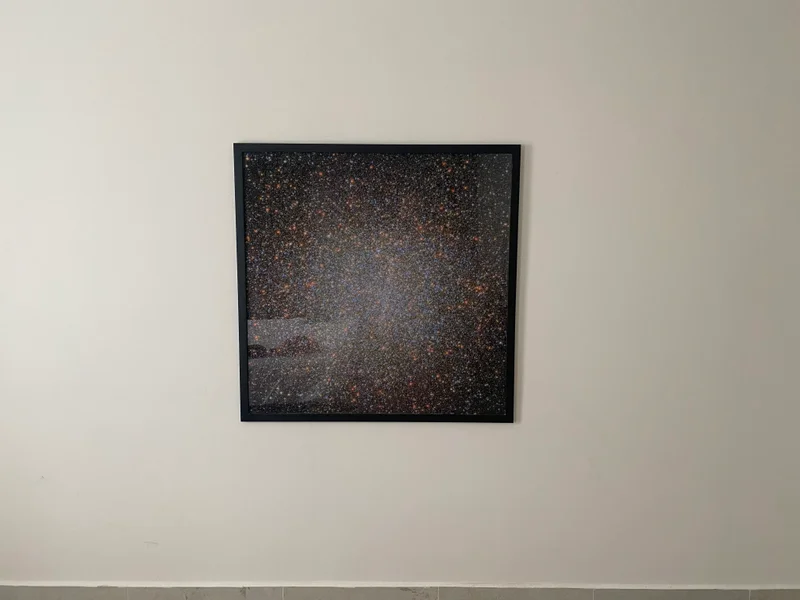
It's a time machine. Captured by the Wide Field Imager on ESO's MPG/ESO 2.2-metre telescope at La Silla Observatory, this one-degree field reveals a breathtaking celestial menagerie in our closest major galactic neighbor: the Large Magellanic Cloud.
Every star tells a story. Every cluster holds secrets. Every glowing wisp marks where giants once lived—and died.
Our Galactic Neighbor's Dramatic Biography
The Large Magellanic Cloud isn't just a pretty sight in Southern Hemisphere skies—it's a survivor. This dwarf galaxy, weighing in at 10% the mass of the Milky Way, recently scraped past our galaxy in what astronomers call a "close encounter of the cosmic kind".
The evidence is written in light across this field: clusters both ancient and impossibly young, supernova remnants still glowing from stellar death throes, and star-forming regions where future suns are taking their first breaths.
At just 180,000 light-years away—practically next door in cosmic terms—the LMC gives us a front-row seat to galactic evolution in action.
The Impossible Cluster That Broke the Rules
Hidden within this stellar tapestry lies one of astronomy's greatest puzzles: a young globular cluster. While the Milky Way's globular clusters are ancient relics from the universe's youth, the LMC hosts clusters like NGC 1850—a mere 50 million years old, practically a cosmic infant.
This shouldn't exist. Traditional theory said globular clusters formed only in the early universe. Yet here it shines, defying expectations and rewriting textbooks.
The secret lies in the LMC's tumultuous relationship with its smaller companion, the Small Magellanic Cloud. Every 100 million years, these cosmic dancers sweep close to each other, their gravitational embrace triggering bursts of cluster formation.
Where Stars Go to Die—And Leave Spectacular Calling Cards
This field captures the aftermath of stellar violence: supernova remnants like N103B, the ghostly remains of a Type Ia supernova. When a white dwarf star reached critical mass and exploded, it left behind expanding shells of superheated gas—orange-red filaments that mark the shock fronts of cosmic destruction.
The explosion wasn't perfect. The remnant's elliptical shape tells us the blast wave hit dense interstellar material, creating an asymmetric expansion that continues today. These stellar death throes occurred relatively recently in cosmic time, making N103B a Rosetta Stone for understanding how massive stars end their lives.
A Laboratory for Stellar Birth and Death
This single field encompasses the entire lifecycle of stars. Young massive clusters blaze with the light of recently ignited nuclear furnaces. Older clusters show the steady march of stellar evolution. Supernova remnants mark where the most massive stars have completed their journey from birth to explosive death.
The LMC has been particularly active in recent cosmic history. Studies reveal that about 15% of all stars in this galaxy formed in long-lived clusters—a rate that speaks to periods of intense star formation triggered by galactic interactions.
Captured by a 67-Million-Pixel Giant
This extraordinary detail comes courtesy of the Wide Field Imager—a technological marvel with 67 million pixels and a field of view large enough to encompass the full Moon. Mounted on the MPG/ESO 2.2-metre telescope, this instrument has become one of ESO's most productive imaging systems.
The one-degree field of view captures cosmic drama on an unprecedented scale—from individual stars to vast stellar associations, from delicate supernova remnants to robust globular clusters.
Perfect for Your Space
-
Art Collectors: Own a piece of cosmic cartography—a detailed map of our galactic neighborhood's most dynamic region.
-
Space & Science Lovers: Display the universe's ultimate laboratory where stellar birth, life, and death play out in spectacular fashion.
-
Interior Designers: Transform any room with this rich stellar tapestry that spans cosmic time from young clusters to ancient remnants.
-
Gift Seekers: Give the gift of perspective. This isn't just another galaxy—it's our cosmic companion, shaped by billions of years of gravitational dance.
-
Anyone Creating Original Spaces: Step beyond ordinary astronomical images into a detailed exploration of galactic evolution.
Museum-Quality Craftsmanship Meets Cosmic Discovery
Every Astrography print represents our commitment to bringing you the universe's most compelling stories. We meticulously curate only the most scientifically significant, artistically stunning images that challenge your perception while delivering exceptional beauty.
Choose from our Fine Art prints with 200+ year archival quality for collectors who demand permanence, or our budget-friendly poster option to make cosmic discovery accessible to everyone.
This is what our galactic neighborhood looks like when you have 67 million pixels and perfect Chilean skies.
This detailed section of the Large Magellanic Cloud (LMC) is a vibrant tapestry of creation and destruction, a reminder of the dynamic, breathtaking universe we inhabit. It’s more than decoration; it’s inspiration.
Purchase now.



 Collected by this store· 0 found this helpful