Looking Back 12.9 Billion Years. The Universe's Greatest Optical Illusion.
This is not a photograph of the present.
This is a message from the universe's infancy.
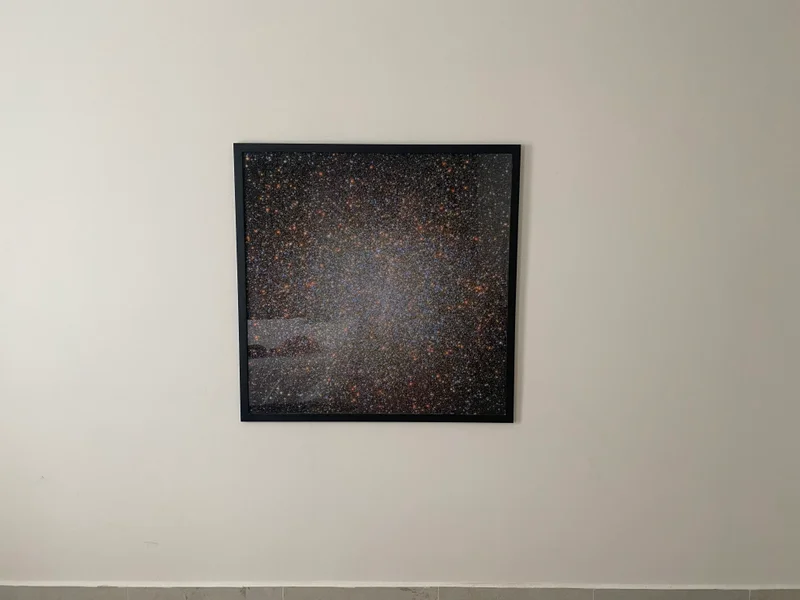
"JWST: Sunrise Arc" captures one of the most scientifically profound and visually stunning discoveries of our time: a glimpse into the universe's first billion years, made possible by two forces working in perfect alignment—human genius and the laws of physics Einstein predicted 110 years ago.
The Science Behind the Wonder
In 2022, the Hubble Space Telescope detected something impossible: a single star 12.9 billion light-years away. Called Earendel (Old English for "morning star"), it shines from inside the "Sunrise Arc," a distant galaxy so warped and magnified by gravity that its light stretches across space like a red ribbon.
How can we see a single star from the edge of the observable universe?
Gravitational lensing
Between us and Earendel sits an entire galaxy cluster—so massive it bends spacetime itself. Light from Earendel passes through this cosmic wrinkle, getting bent, stretched, and magnified over 4,000 times brighter than it would naturally appear. Without this gravitational magnifying glass, Earendel would be invisible. With it, we see a star born less than a billion years after the Big Bang.
When James Webb's infrared camera (NIRCam) turned to look, the follow-up revealed even more:
-
Earendel is a massive B-type star, more than twice as hot as our Sun.
-
It's a million times more luminous than our Sun.
-
Hints of a companion star appear in its spectrum—a red, cooler partner locked in orbit.
-
Young star-forming regions less than 5 million years old glow across the arc.
-
Ancient globular clusters 10+ million years old reveal what our Milky Way's oldest stars looked like in their prime.
This is not just a beautiful image.
This is a window into deep time.
Why This Image Moves People
Some see cosmic triumph: we built a telescope so powerful, so sensitive, so precisely engineered, that we can see individual stars from the universe's dawn. We've touched the untouchable. We've reached back through 12.9 billion years and glimpsed creation itself.
Others see humbling insignificance: a single point of light so far away that everything we know—every civilization, every war, every love story—unfolded during the light's journey to us. We are smaller than we thought.
Both reactions are right.
That's what great cosmic art does. It forces you to hold two truths at once:
Awe at human capability. Awe at the universe's scale.

Who This Print Speaks To
For Science & Astronomy Lovers
This image represents a paradigm shift in observational astronomy. James Webb has opened a new era of deep-space discovery. Owning this print means living with the frontier—watching the universe reveal its oldest secrets on your wall.
For Art Collectors
The Sunrise Arc is compositionally extraordinary: a deep cosmic field with hundreds of galaxies scattered across black space, punctuated by the delicate red crescent of the warped galaxy and the bright beacon of Earendel at its center. It's Hubble-photograph aesthetics meeting fine-art visual power. The contrast, the color palette, the sense of depth—it hangs like nothing else.
For Educators & Institutions
Whether in a classroom, observatory, science museum, or university office, this print teaches gravitational lensing, stellar physics, and cosmology through visual impact. It's a conversation starter that leads to bigger conversations about the early universe.
For People Who Feel Wonder
You look up at the night sky and feel something move in your chest. This image captures that feeling and makes it concrete—proof that the universe is more strange, more beautiful, and more vast than we can really comprehend. This belongs in a space dedicated to the things that matter: curiosity, discovery, hope.
For Interior Designers & Visionary Spaces
Deep black background. Rich reds and blues from distant galaxies. The subtle geometric arc. This is a print that anchors a room. It works in modern observatories, tech company offices, creative studios, high-end homes, and any space where you want to communicate, "We think big here."
Astrography Quality: The Universe Deserves More Than a Poster
Astrography doesn't frame NASA images and call it done.
We curate.
We hunt.
We find the photographs that change how you see the cosmos.
Then we transform them into heirloom-quality prints:
-
Fine Art Edition: Museum- and gallery-grade printing with archival paper, archival inks, and a lifespan of 200+ years. This is for collectors who understand that great images deserve great presentation.
-
Poster Edition: An accessible entry point for space lovers and students who want Earendel on their wall without the premium investment, but with quality standards that still exceed typical poster production.
Every print is produced with obsessive attention to color accuracy, contrast, and detail—so what you unbox feels like a piece of the cosmos itself, not a mass-produced flat thing.
Searching for authentic James Webb Space Telescope wall art?
This Sunrise Arc print brings the universe's oldest light into your home—a photograph of Earendel, the most distant star ever detected, captured by humanity's most powerful space telescope.
Perfect for:
-
Science enthusiasts who follow the latest deep-space discoveries.
-
Students and educators exploring cosmology and gravitational lensing.
-
Offices and creative spaces that celebrate human curiosity and exploration.
-
Fine-art collectors seeking museum-quality space photography.
-
Dreamers and wanderers who need to be reminded that the universe is infinitely stranger and more beautiful than we imagine.
Earendel lived. Earendel shone. Earendel's light reached us across 12.9 billion years of cosmic expansion. Now you can look at it every day and remember that we're the generation that saw it.
The universe's oldest light is finally within reach.
Choose your edition. Select your size. Bring 12.9 billion years of cosmic history into your space.
Credit
- Image: NASA, ESA, CSA;
- Science: Dan Coe (STScI/AURA for ESA, JHU), Brian Welch (NASA-GSFC, UMD);
- Image Processing: Zoltan Levay


 Collected by this store· 0 found this helpful